Insights · Enterprise Use Cases
AI-native EU project preparation needs more than generated application text
Strong EU project preparation depends on evidence, consortium logic, ownership, impact, dependencies and evaluator-ready challenge.
Generated prose can make an application sound complete while its consortium, evidence or implementation logic remains weak. AI-native preparation should govern the reasoning before it accelerates the writing.
01
Start with call context and problem definition
A credible workflow maps call objectives, eligibility, expected outcomes and evaluation logic before drafting. The problem definition must identify whose condition changes, why existing approaches are insufficient and what evidence supports the need.
AI can structure source material and identify gaps, but experts must interpret policy nuance and strategic fit.
02
Excellence, Impact and Implementation
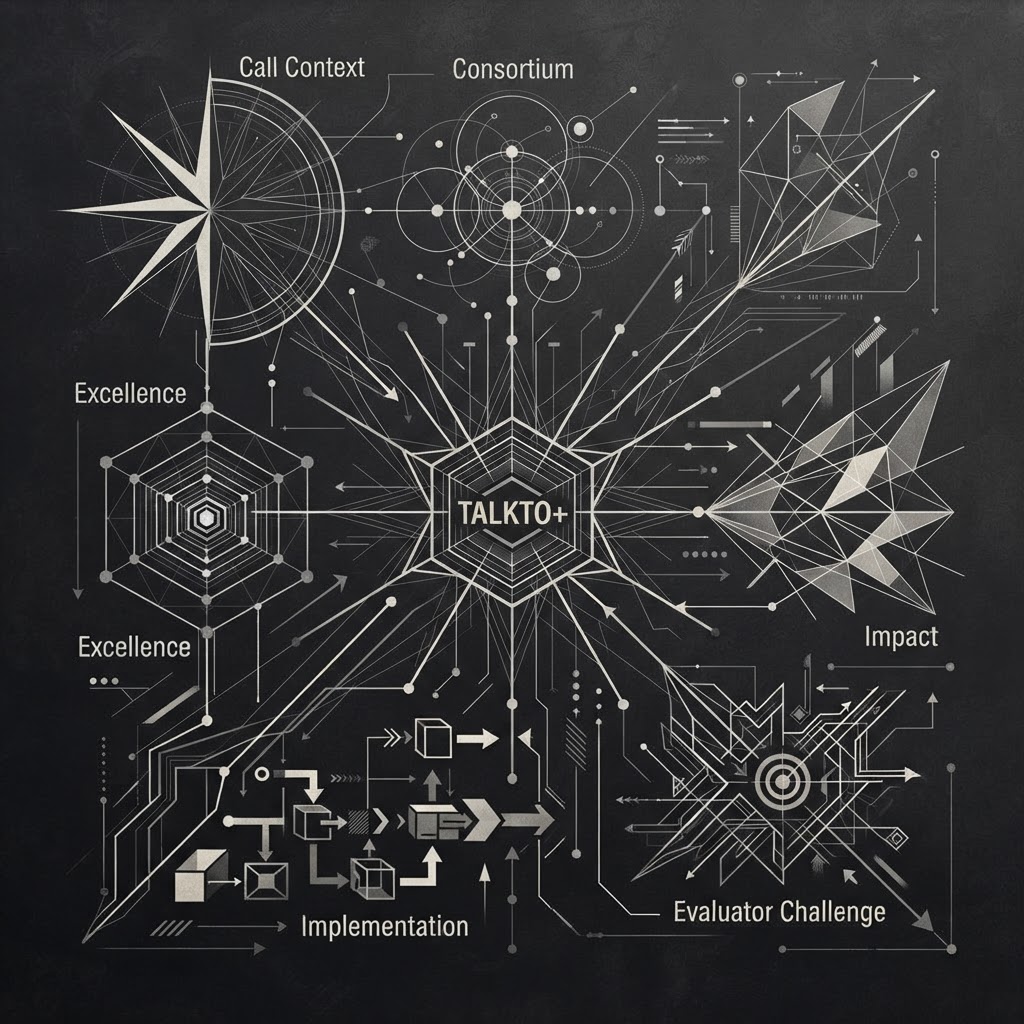
Excellence requires a coherent concept, method and advancement beyond current practice. Impact connects outputs to adoption, beneficiaries and plausible change. Implementation shows work, resources, governance and risk.
The sections should form one logic. A claim in Impact must be supported by activities and ownership in Implementation, not invented during narrative polishing.
Evaluator-ready preparation is a chain of evidence and ownership, not a volume of fluent text.
03
Consortium roles and work packages
Partners should have necessary, distinct and accepted roles. Work packages need outputs, dependencies, decision rights and interfaces. A famous organization with no operational contribution can weaken credibility rather than strengthen it.
The workflow can expose overlaps, missing capabilities and dependencies before commitments harden.
04
Assumptions and evidence
Applications rely on assumptions about users, regulation, technology, market uptake and partner capacity. Each material assumption should have evidence, an owner and a consequence if false.
Evidence references allow reviewers to distinguish validated need from aspirational language. Gaps can become research tasks or reasons to narrow scope.
05
Red Team and evaluator perspective
A Red Team review adopts evaluator questions: Is the advancement clear? Is impact plausible? Can the consortium deliver? Are dependencies controlled? It looks for contradictions across sections, not just weaknesses in wording.
Rejected alternatives and unresolved concerns remain documented so leadership knows what risk is being accepted at submission.
06
Early-kill decisions
Some opportunities should stop early because strategic fit, eligibility, evidence or consortium capability is insufficient. An early-kill gate protects scarce expert time and partner trust.
Stopping is not failure. It is a readiness decision based on current conditions, and the evidence can remain useful for a later call.
07
Readiness before submission
Submission readiness covers content completeness, evidence, partner acceptance, work-package consistency, budget logic, risks and final approvals. A polished document is necessary but not sufficient.
Generic text generation cannot create genuine partner commitment, validated impact or executable ownership. AI creates value when it helps the workflow test and trace those conditions.
FAQ
Direct answers
Can AI write an EU application?
It can support drafting and review, but credible preparation requires expert evidence, consortium commitment and accountable decisions.
What is an early-kill gate?
It is a structured decision to stop weak opportunities before they consume disproportionate preparation effort.
Continue reading
Related articles

From Slack and Excel to ERP and CRM: building a governed enterprise data fabric
Enterprise execution data becomes useful when it is normalized, governed and mapped to a defined workflow purpose.
Read article →
Execution Readiness: what leadership should know before commitment
A structured way to evaluate whether a plan has sufficient clarity, ownership, evidence and capability to move forward.
Read article →
Human validation is not a limitation of enterprise AI — it is part of the architecture
Accountable human decisions remain essential when AI observations influence workflows, risks and leadership action.
Read article →