Insights · AI Governance
Human validation is not a limitation of enterprise AI — it is part of the architecture
Accountable human decisions remain essential when AI observations influence workflows, risks and leadership action.
Enterprise AI becomes dependable when the architecture assigns machines and people the work each can responsibly perform. Human validation is the control that connects probabilistic observations to accountable organizational action.

01
Accountability defines the boundary
AI can propose, classify and synthesize, but it cannot hold a legal mandate, accept business consequence or understand every local implication. Accountable humans decide when evidence is adequate and which residual risks the organization will carry.
Architecture should make that boundary explicit. A human name added after generation is not enough; the reviewer needs authority, context, evidence and a clear decision request.
02
AI confidence and uncertain evidence
Model confidence, where available, does not equal factual certainty. Uncertain evidence, conflicting sources and weak context should lower the operational authority of an output even when the language is persuasive.
Interfaces should reveal source coverage, assumptions and unresolved challenge. Reviewers can then focus on material uncertainty rather than proofreading prose.
Accountability cannot be delegated to model confidence.
03
Review roles and the four-eyes principle
Different questions require different validators. A specialist confirms domain interpretation, a Workflow Steward checks process discipline and an accountable owner accepts action. The four-eyes principle adds independent review for consequential transitions.
Independence matters. Two approvals based on the same assumption or copied interpretation do not provide meaningful challenge.
04
Escalation and stage gates
A workflow should escalate when evidence is insufficient, reviewers disagree, confidence falls below policy or consequence exceeds the current role. Stage gates prevent unresolved conditions from disappearing into later work.
Escalation does not always mean stopping. A conditional state can permit bounded progress with named controls, while a blocked state protects against irreversible commitment.
05
Correction, recall and auditability
Validated outputs can later become wrong because evidence changes. Correction updates the finding; recall identifies downstream decisions or actions that relied on it; revalidation determines what remains acceptable.
An audit trail preserves the original context, change rationale and approvals. This supports learning without rewriting history.
06
When automation is appropriate
Automation is suitable when tasks are bounded, consequences are low, outputs are reversible and performance can be monitored. Examples include document classification, routing, extraction and reminders under defined policy.
Human judgment is required when evidence is ambiguous, values conflict, impact is material or the decision changes rights, commitments or strategic direction.
07
Validation as an enabling architecture
Well-designed validation does not force humans to inspect every token. It concentrates review on exceptions, material findings and stage transitions. Reusable criteria and evidence views make review faster and more consistent.
The result is not slower AI but governable AI. Organizations can automate suitable work confidently because the architecture knows when to stop, ask, challenge and record a human decision.
FAQ
Direct answers
Does human validation prevent automation?
No. It defines where automation is safe and where accountable review is required.
What is four-eyes approval?
It is independent review by at least two appropriate roles for a consequential transition or conclusion.
Continue reading
Related articles
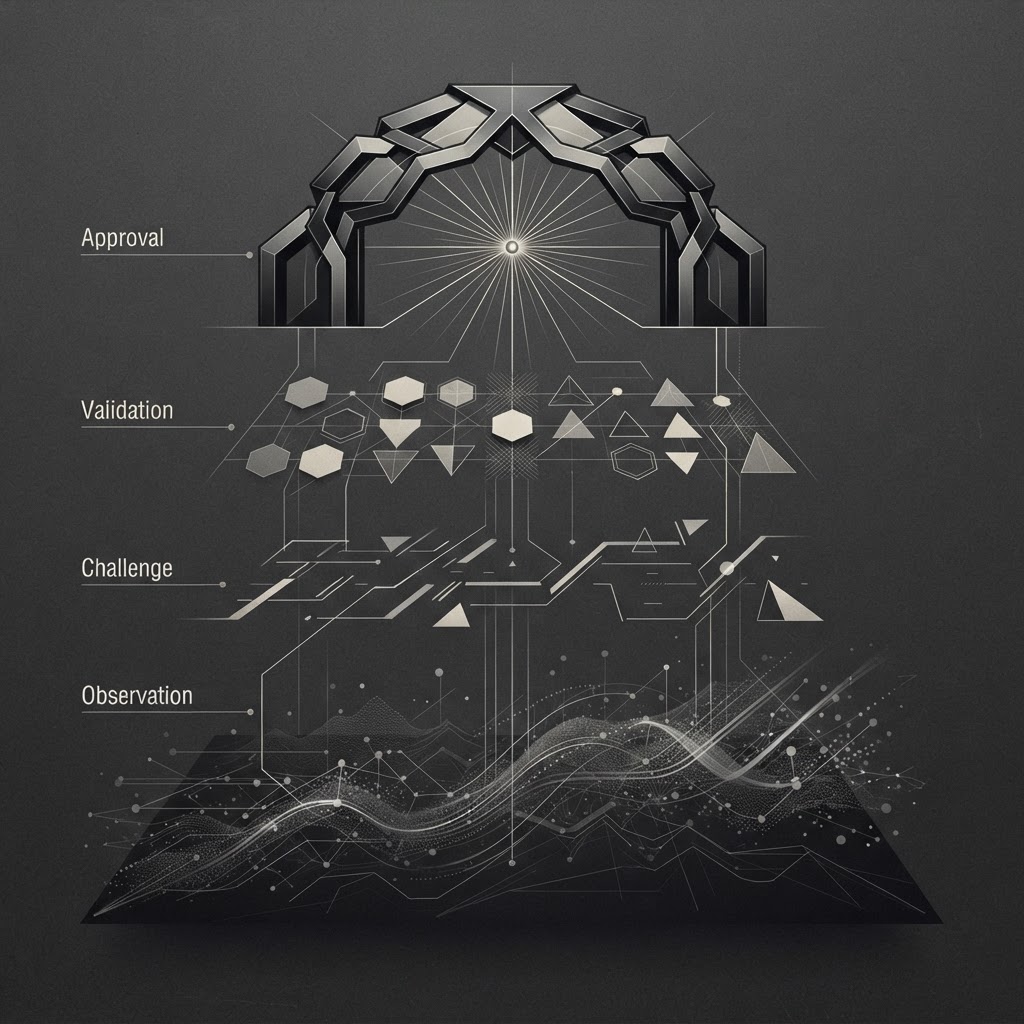
Evidence first: preventing AI observations from becoming organizational truth
AI output should remain an observation until evidence, challenge and human validation justify operational use.
Read article →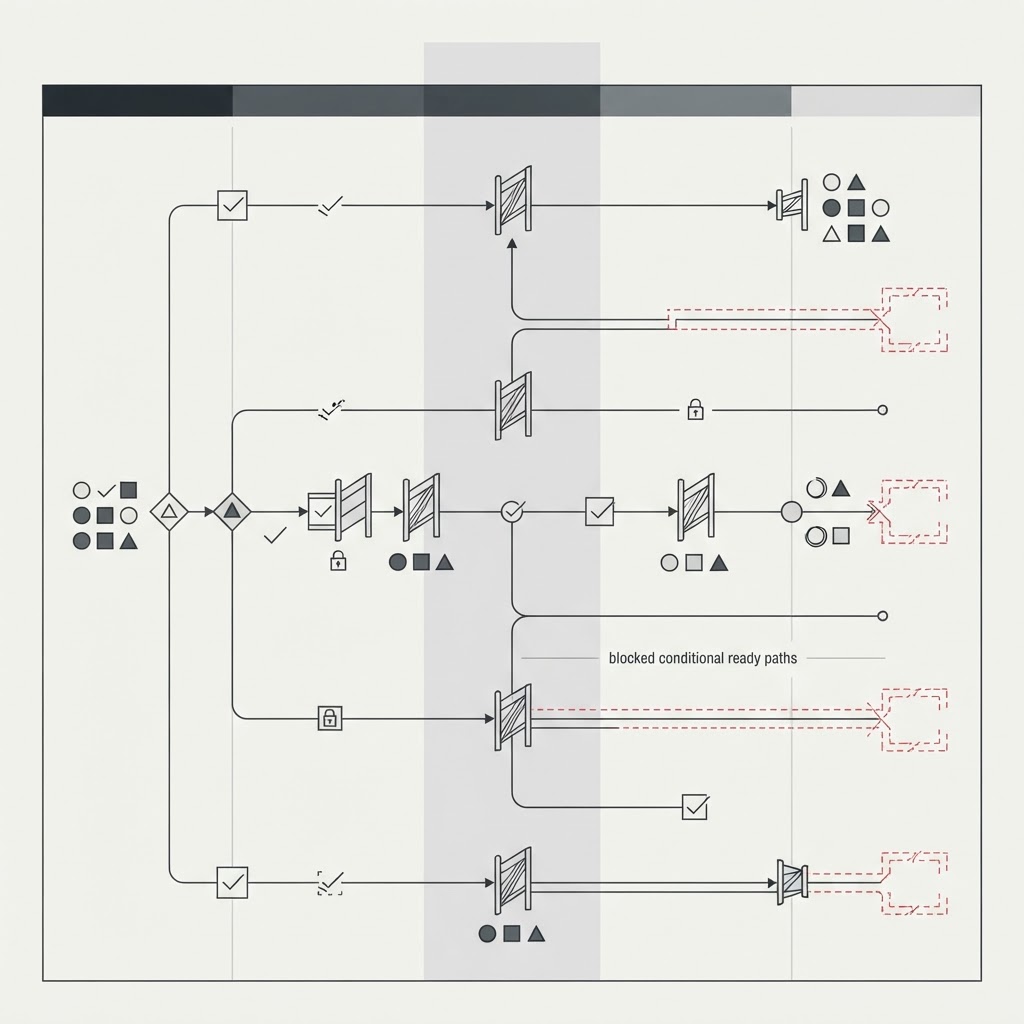
Execution Readiness: what leadership should know before commitment
A structured way to evaluate whether a plan has sufficient clarity, ownership, evidence and capability to move forward.
Read article →
Why every critical workflow needs a structured dissent mechanism
Red Team reviews and mandatory divergent views reduce collective blindness and expose weak conclusions before commitment.
Read article →