Insights · AI Governance
Evidence first: preventing AI observations from becoming organizational truth
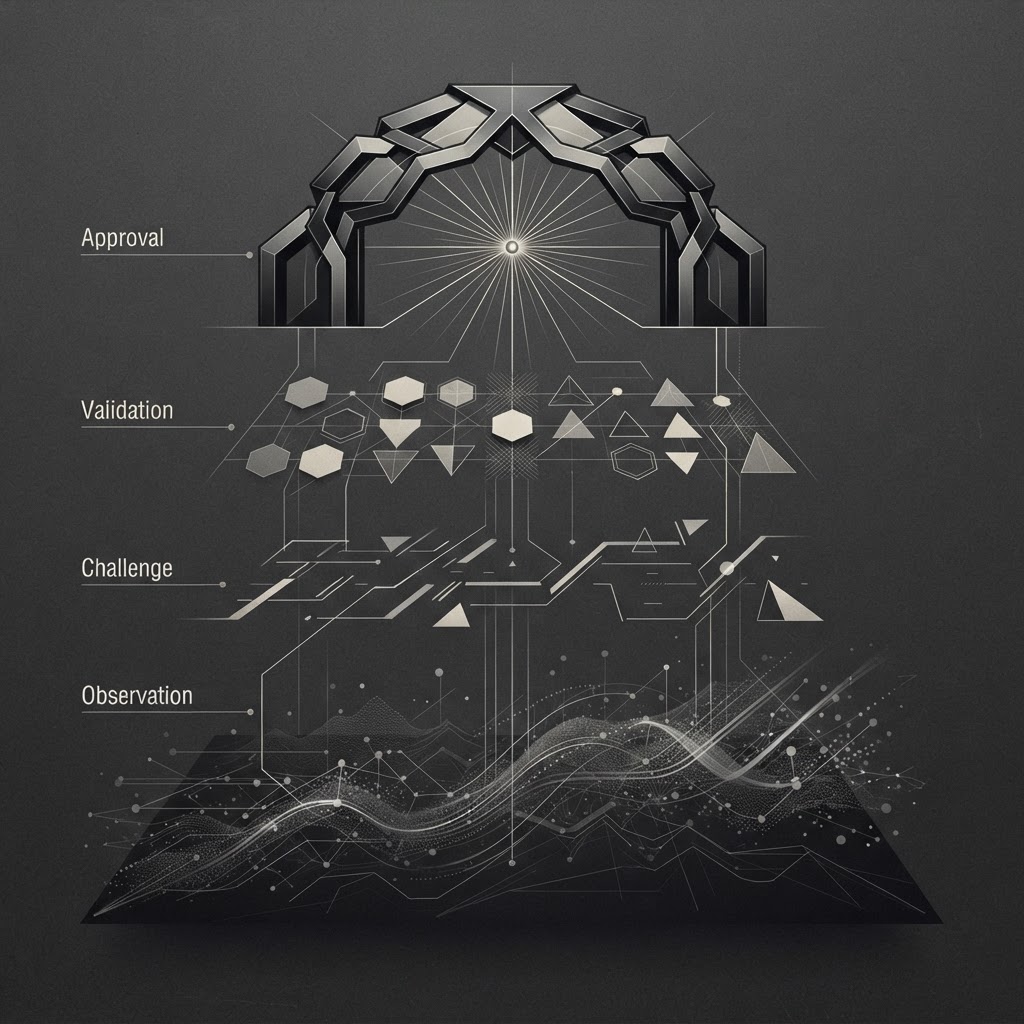
AI output should remain an observation until evidence, challenge and human validation justify operational use.
Fluent language creates an impression of certainty. Evidence-first governance prevents a plausible AI observation from becoming an operational fact simply because it is clear, repeated or convenient.
01
Observations are not facts
An AI observation is a proposed interpretation of available context. It may identify a contradiction, pattern or missing condition, but it can also reflect incomplete sources, ambiguous language or model bias. The workflow should label it accordingly.
Facts require appropriate evidence and scope. Even a verified document may prove only that a statement was recorded, not that the underlying condition exists. Governance preserves this distinction.
02
Evidence references and confidence
Every consequential observation should reference the evidence that supports it. Reviewers need access to source, version, context and relevant excerpt. Confidence should describe the strength of the support, not the tone of the generated text.
Multiple citations do not create independence if they repeat one origin. Evidence mapping should reveal shared sources and conflicting records.
An AI observation should not become a leadership truth without evidence, critical challenge and human validation.
03
Assumptions and validation
Where evidence is incomplete, the system should state the assumption and its consequence. Validators can confirm, qualify, reject or request more evidence. Their role and rationale become part of the record.
Validation is not a generic approval click. A domain expert may validate technical interpretation while an accountable owner accepts operational consequence. Roles should match the question.
04
Red Team challenge
Red Team review asks what could make the conclusion wrong, which perspective is missing and whether alternative explanations fit the evidence. The challenge should be structured and evidence-based rather than performative disagreement.
A finding that survives challenge becomes stronger. A finding that changes demonstrates governance working as intended, not failure. Rejected alternatives should remain documented with reasons.
05
Model-run and audit traceability
Model-run traceability records provider, model, workflow stage, relevant configuration and input references without exposing unnecessary sensitive content. The audit trail also records edits, validation, approval and recall.
This allows reviewers to reconstruct how an observation became actionable and to identify outputs affected by a later model or evidence issue.
06
Human approval and operational use
High-impact findings should not change ownership, escalate risk or inform leadership action without accountable approval. Lower-risk automation may proceed under policy when outputs are reversible, monitored and bounded.
The threshold depends on consequence, not novelty. A familiar automated classification can still require review if it affects a material decision.
07
Managing false certainty
False certainty grows when polished summaries remove caveats, dashboards compress uncertainty and repeated outputs reinforce one interpretation. Interfaces should keep confidence, missing evidence and dissent visible near the conclusion.
Evidence-first governance creates a healthy delay between observation and truth. The delay is purposeful: it gives the organization time to test what matters before the statement acquires operational authority.
FAQ
Direct answers
Can AI output ever be used automatically?
Yes, for bounded and reversible tasks under policy; consequential interpretations require proportionate validation.
What does confidence mean?
It describes support and uncertainty, not a guarantee that a conclusion is correct.
Continue reading
Related articles

Human validation is not a limitation of enterprise AI — it is part of the architecture
Accountable human decisions remain essential when AI observations influence workflows, risks and leadership action.
Read article →
Execution Readiness: what leadership should know before commitment
A structured way to evaluate whether a plan has sufficient clarity, ownership, evidence and capability to move forward.
Read article →
Cascade risk: what happens when one weak assumption spreads through the enterprise
A single false assumption can propagate through technology, process, decisions and organizational behavior.
Read article →